
Contract Manufacturing vs Private Label Manufacturing: Which Is Better for Established Cosmetic Brands?
Both models let you outsource production — but they serve very different growth strategies. Here’s how to choose the right one for your brand’s next stage.
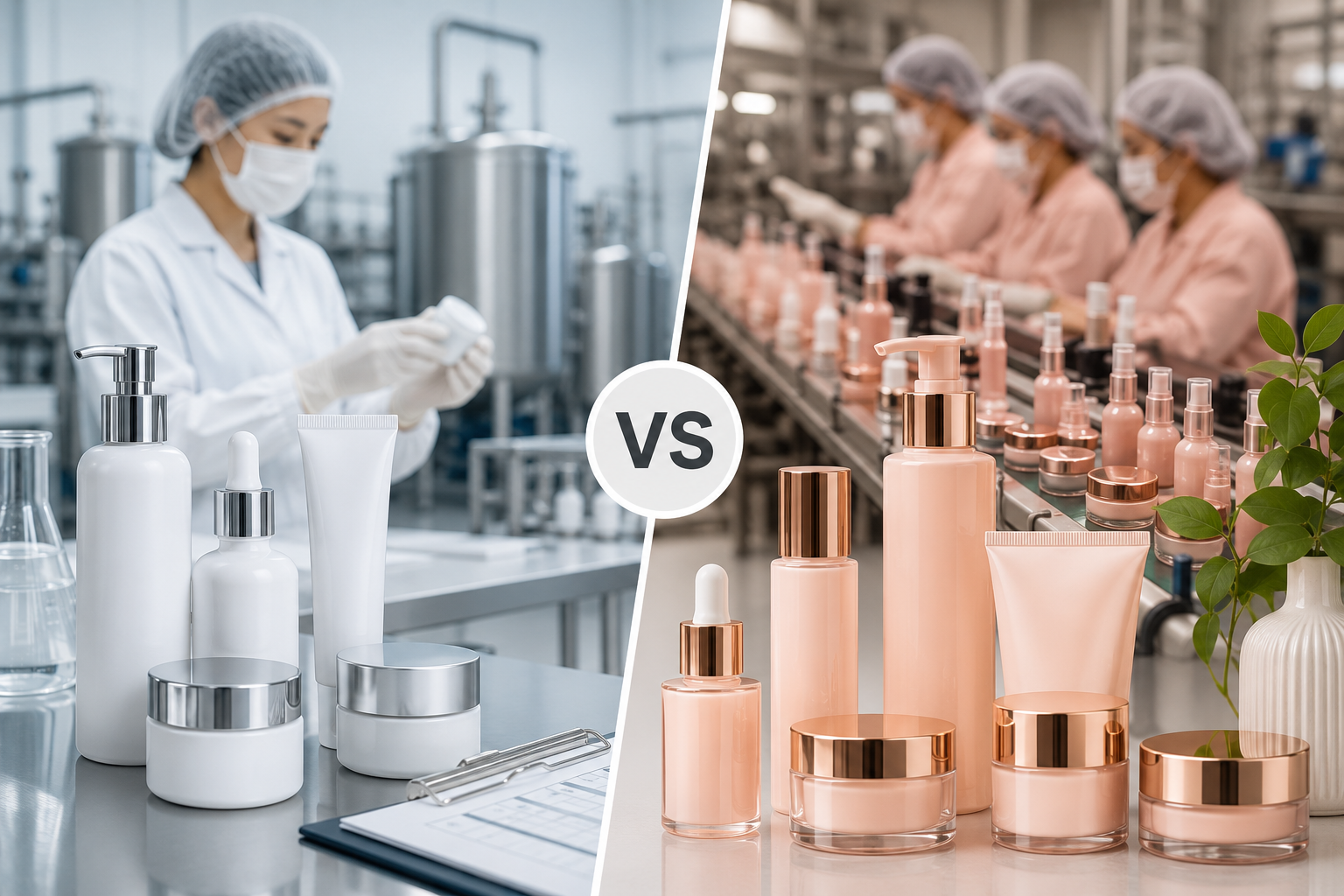
Launching a cosmetic brand is one challenge — scaling it successfully is another. As brands expand into new product categories, markets, and customer segments, manufacturing becomes a strategic decision rather than just an operational one.
One of the most common questions established brands ask is whether to choose contract manufacturing or private label manufacturing. While both models allow businesses to outsource production, they differ significantly in terms of customization, ownership, flexibility, and long-term growth. Understanding these differences can help established cosmetic brands select the right manufacturing strategy to support innovation and expansion.
Private Label Manufacturing
Sell products under your own brand name while leveraging the expertise and infrastructure of an experienced manufacturer — ideal for launching quickly with minimal operational complexity.
- Ready-to-market formulations
- Customizable existing formulations
- Dedicated R&D support for unique formulas
Contract Manufacturing
Outsource complete production based on your own formulations, specifications, or requirements — built for brands that need full control over product innovation and IP.
- Custom product development
- Exclusive formulations
- Larger production volumes & long-term partnerships
Contract manufacturing vs private label manufacturing
Although both models involve third-party production, they serve different business objectives. The right choice depends on your brand’s goals, budget, and product strategy.
| Feature | Private Label Manufacturing | Contract Manufacturing |
|---|---|---|
| Time to Market | Fast | Moderate |
| Product Customization | Moderate to High | Very High |
| Formula Ownership | Varies by agreement | Typically Brand-Owned |
| Initial Investment | Lower | Higher |
| Best For | Growing & expanding brands | Large established brands |
| Production Flexibility | High | High |
| Product Development | Existing or modified formulations | Fully customized formulations |
When private label manufacturing is the better choice
Private label manufacturing is ideal when an established brand wants to move fast without overextending its investment.
Launch New Product Categories Quickly
Instead of spending months on formulation development, brands can introduce new products using proven formulations and customize them according to market requirements.
Reduce Time to Market
Consumer trends change rapidly. Private label manufacturing enables brands to capitalize on market demand without lengthy development cycles.
Expand With Lower Risk
Launching every product from scratch can be expensive. Private labeling allows brands to validate market demand before investing heavily in exclusive product development.
Test the market first — then decide where exclusivity is worth the investment.
When contract manufacturing is the better choice
Contract manufacturing becomes advantageous when brands require complete control over product innovation.
Exclusive Formulations
Products developed exclusively for one brand cannot be replicated for competitors, creating long-term differentiation.
Proprietary Ingredient Technologies
Premium skincare brands often invest in unique ingredient combinations and patented delivery systems. Contract manufacturing supports this level of innovation through dedicated R&D.
Large-Scale Production
Established brands supplying nationwide retailers or export markets often require consistent, high-volume production. Contract manufacturing provides structured production planning to support large-scale operations.
Built for brands scaling into national retail and export markets.
Key factors to consider before choosing a manufacturing model
These factors matter regardless of which manufacturing model you choose — and your manufacturing partner should be capable of growing alongside your brand.
Why many established brands use both models
Many successful cosmetic companies don’t rely on only one manufacturing model. Instead, they combine both strategically: private label for fast launches, trend-driven collections, and market testing — and contract manufacturing for hero products, signature ranges, and premium lines.
At Gladios Products Pvt. Ltd., our systems are built to support both approaches under one roof, so you can balance rapid growth with long-term differentiation.
Talk To Our Team- Private label skincare manufacturing
- Custom formulation & product R&D
- Flexible production volumes for both models
- Packaging coordination & label design
- GMP-aligned manufacturing processes
- Quality testing & documentation
- Dedicated account management across both models
Questions to ask before choosing a manufacturing model
The right model isn’t universal — it’s the one that matches your growth strategy
There is no universal answer to the contract manufacturing vs private label manufacturing debate. The best choice depends on your business goals, product strategy, investment capacity, and growth plans.
Private label manufacturing offers speed, flexibility, and lower risk, making it ideal for expanding product portfolios and responding to market trends. Contract manufacturing provides complete customization and proprietary product development, making it the preferred option for brands focused on innovation and exclusivity. For many established cosmetic brands, combining both models delivers the best balance between rapid growth and long-term differentiation.
Great content! Keep up the good work!